
Web Hosting Company in Egypt
Choosing the right web hosting service is a decision that directly affects your website speed, security, Google ranking, and User Experience. Many people choose the cheapest hosting plan and later face slow performance, frequent downtime, or security problems.
In this guide, you will understand the real differences between Shared Hosting, Reseller Hosting, VPS servers, and Dedicated Servers, including the advantages, disadvantages, and when to choose each type, in a way that supports SEO and useful-content principles.
First: What Is Web Hosting?
Web hosting is simply the “place” where your website lives. It stores your website files, database, email accounts, and server configurations.
Depending on the type of hosting you choose, this environment may be shared with other websites, divided into dedicated virtual resources, or fully dedicated to your project.
In this case, you can choose a professional web hosting company in Egypt.
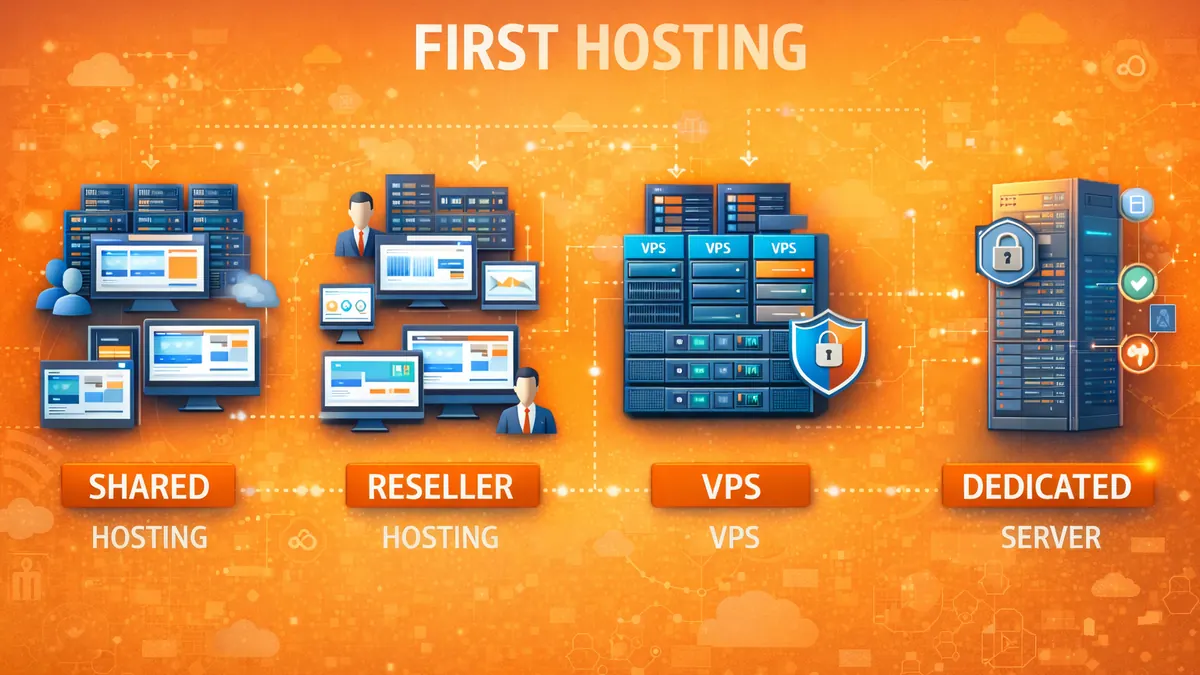
1) Shared Hosting
The Concept
With Shared Hosting, your website shares the same physical server with many other websites.
All websites use the same server resources, including CPU, RAM, and disk storage, although usage levels may vary.
Advantages
-
Lower cost and suitable for limited budgets.
-
Easy to use, often through cPanel, and does not require advanced technical knowledge.
-
Suitable for new websites, small businesses, service pages, and beginner blogs.
Disadvantages
-
Performance may not always be consistent. If another website on the same server consumes a large amount of resources, your website may be affected.
-
Clear limitations on resources and server configurations.
-
In some cases, “bad neighbor” issues may occur. If another website on the server is involved in spam or security problems, the shared IP reputation may be affecte
Suitable For
-
Small business websites
-
Portfolios
-
Small blogs
-
Landing pages
-
Websites that do not expect very high traffic
Web Hosting Companies – Shared Hosting
2) Reseller Hosting
The Concept
Reseller Hosting allows you to create multiple hosting accounts for your clients, as if you are providing hosting services under your own management.
It often includes control panels such as WHM for managing customer accounts.
Advantages
-
Excellent if you are a web design company or provide website services to clients and want to host their websites.
-
Clients can be divided into separate accounts, with each client having their own storage, email, and databases.
-
Easier to manage than full servers because much of the server administration is still handled by the hosting provider.
Disadvantages
-
It is often still based on a shared hosting environment, so you depend on your hosting provider’s server infrastructure.
-
You have greater responsibility for customer technical support, even if the problem comes from the hosting server.
-
Resources may become limited as the number of customers increases.
Suitable For
-
Marketing agencies
-
Web development companies
-
Freelancers managing multiple client websites
-
Businesses managing multiple domains and email accounts
3) VPS – Virtual Private Server
The Concept
A VPS is a virtual server created inside a powerful physical server.
You receive a dedicated share of resources such as RAM, CPU, and storage, with much more control over the server environment than Shared Hosting.
Advantages
-
More stable performance than Shared Hosting because resources are allocated to your VPS.
-
Greater control over server configurations, PHP versions, Nginx or Apache, security settings, and advanced caching.
-
Suitable for scaling, as resources can often be upgraded quickly.
-
Stronger security options, including firewalls, better isolation, and more detailed configurations.
Disadvantages
-
Requires technical experience or a System Administrator, especially if the VPS is unmanaged.
-
If the server is not configured correctly, including firewalls, updates, and backups, it may become vulnerable to security risks.
-
More expensive than Shared Hosting and Reseller Hosting.
Suitable For
-
Websites with medium to high traffic
-
E-commerce stores
-
Medium-sized news websites
-
Systems requiring custom server configurations
-
Multiple websites that require professional management
Important Note: There are two main types of VPS hosting:
Managed VPS, where the hosting provider handles basic server management and support, and Unmanaged VPS, where you are responsible for the server administration.
4) Dedicated Server
The Concept
A Dedicated Server is a complete physical server dedicated entirely to your website or project.
You receive 100% of its resources without sharing them with other customers.
Advantages
-
High performance and stability because you do not share the server with anyone else.
-
Full control over security, networking, databases, operating systems, and other configurations.
-
Suitable for large and critical projects with high traffic or advanced security requirements.
-
High flexibility for running multiple services on the same server.
Disadvantages
-
Higher cost.
-
Requires highly professional server management, including monitoring, updates, backups, and security.
-
Scaling may not always be as simple as upgrading a VPS and may require hardware upgrades or migration.
Suitable For
-
Very large news websites
-
Large e-commerce platforms
-
SaaS platforms
-
Large databases
-
Projects requiring full control or advanced security compliance
Quick Comparison to Help You Choose
-
Shared Hosting: Affordable and easy to use, but performance may vary and resources are limited.
-
Reseller Hosting: Excellent for managing client websites, but it does not provide the same performance level as a VPS.
-
VPS: A strong balance between cost, performance, and control, and often a natural upgrade for growing websites.
-
Dedicated Server: The highest level of control and resources, but it requires a larger budget and professional management.
How Does Web Hosting Affect SEO and Google Rankings?
Google does not automatically penalize a website because of the type of hosting it uses.
However, hosting can affect several technical and User Experience factors that influence search performance.
Speed and Core Web Vitals
Weak hosting can lead to slow loading times, which can negatively affect User Experience and website performance.
Uptime
Frequent server downtime can prevent search engine crawlers from accessing and indexing the website properly.
Security
Hacking, malware, or other security problems may result in browser warnings or search engine issues.
Time to First Byte – TTFB
TTFB is an important performance metric and can be directly affected by hosting quality and server configuration.
Tips for Following Google Guidelines and Helpful Content Principles
To help your website follow general Google guidelines and useful-content principles:
-
Create educational content that clearly answers users’ questions.
-
Avoid keyword stuffing and focus on meaning and usefulness.
-
Provide accurate information and real details about resources, hosting capacity, and management options.
-
Create clear website pages such as About Us, Privacy Policy, and Contact Us, especially for commercial websites.
-
Focus on website speed, mobile User Experience, and organized internal linking.
Frequently Asked Questions
Is VPS Better Than Reseller Hosting?
If your main goal is performance, control, and scalability, VPS is often the more suitable option.
If your goal is to manage many client websites easily, Reseller Hosting may be more appropriate.
When Should I Upgrade from Shared Hosting to VPS?
You may consider upgrading when:
-
Website traffic increases significantly
-
The website becomes consistently slow
-
You need custom server configurations
-
You operate an e-commerce or news website that requires greater stability
Is a Dedicated Server Necessary?
Not always.
Many projects can perform very well on a powerful Managed VPS.
A Dedicated Server is usually considered when traffic and resource requirements become very large or when a project has special security or infrastructure requirements.