Custom Development vs WordPress: Which Is Better for Your Website?
The Difference Between Custom Development and WordPress
Custom Development or WordPress, Difference Between WordPress and Custom Development, WordPress Advantages, WordPress Disadvantages, Custom Development Advantages, Custom Development Disadvantages, Website Development Cost, Best Way to Build a Website
Learn the difference between custom development and WordPress in terms of cost, speed, security, customization, and performance, and discover the factors that can help you choose the right solution for your website.
Introduction
Having a website has become one of the most important steps for companies, business owners, and entrepreneurs in the digital age. However, before starting a website project, several important questions usually arise, one of the most common being: Should I use WordPress or choose custom development?
The difference between custom development and WordPress is one of the most frequently searched topics among business owners planning to create a new website because each option follows a different approach to building and managing websites.
WordPress provides a ready-made Content Management System that can be customized and expanded using themes and plugins, while custom development involves building the website or system according to the specific requirements of the project.
There is no single option that is suitable for every website. The right choice depends on the nature of the project, the size of the website, the required features, the available budget, the development timeline, and future expansion needs.
In this article, we will explain the difference between custom development and WordPress in detail and compare them in terms of cost, flexibility, performance, security, ease of management, maintenance, and Search Engine Optimization.
What Is Custom Development?
Custom development is an approach to creating websites and digital systems according to the specific needs of a project rather than relying mainly on a ready-made Content Management System.
In this type of project, the development team usually begins by analyzing the client’s requirements, then designing the User Experience and interfaces, followed by developing the system, database, admin dashboard, and various features.
One of the main advantages of custom development is the ability to create features specifically designed for the business.
For example, if a company needs a special system for managing customers, orders, employees, or inventory, developers can design the system according to the company’s internal workflow.
For this reason, custom development is widely used for platforms and systems that require complex features or non-standard functionality.
What Is WordPress?
WordPress is a Content Management System used to create and manage many different types of websites.
WordPress originally became popular as a blogging platform, but today it is widely used to build corporate websites, personal websites, content websites, e-commerce stores, and many other types of online projects.
WordPress relies on themes and plugins that allow website owners and developers to change the design and add many features without having to build everything from scratch.
Ease of management is one of the main reasons WordPress has become a popular option among website owners, as pages, articles, images, products, and other content can be managed through a single dashboard.
The Difference Between Custom Development and WordPress in Terms of Cost
Cost is one of the most important factors to consider when choosing how to build a website.
With WordPress, the initial cost can often be lower, especially when the website requirements can be handled using an existing theme and available plugins.
Custom development, on the other hand, usually requires more time and effort from designers and developers, which means the initial development cost may be higher.
However, it is a mistake to compare the two options based only on the initial price.
A WordPress website may require additional expenses for premium themes, plugins, hosting, maintenance, and future development, while custom development may require a larger initial investment but provides a system designed specifically for the project.
Therefore, the total long-term cost of the website should be considered, not only the initial development cost.
The Difference Between WordPress and Custom Development in Development Speed
One of the main advantages of WordPress is that a website can often be created relatively quickly, especially when the requirements are standard and do not involve complex features.
Instead of building a Content Management System from scratch, developers can use the existing WordPress platform and customize it according to the project’s needs.
Custom development usually requires more time because it involves several stages, including requirements analysis, design, programming, testing, and further development.
The more complex the project’s features become, the more time will usually be required to complete the website.
For this reason, WordPress may be suitable for projects that need to launch quickly, while custom development may be more appropriate for projects that require a specialized system, even if the development process takes longer.
The Difference in Ease of Use and Management
Ease of website management is another important factor to consider before choosing a technology.
WordPress provides a relatively user-friendly dashboard that allows website owners to manage content without requiring advanced programming knowledge.
For example, a website owner can add a new article, edit a page, upload an image, or add a product without contacting a developer every time.
With custom development, ease of management depends on the admin dashboard created for the project.
Developers can build a powerful and user-friendly dashboard, but creating such a dashboard requires additional development time and cost.
Therefore, if daily content management is an important priority for your business, this factor should be carefully considered before making a decision.
The Difference in Flexibility and Customization
When comparing custom development and WordPress, flexibility is one of the most important factors.
Custom development gives developers significant freedom to build the system according to the exact requirements of the project.
They can create custom functions, workflows, and business rules designed specifically for the company.
WordPress also provides a high level of flexibility through themes, plugins, and the ability to create custom plugins and themes. However, it still operates within the basic structure of the WordPress platform.
If a website requires common features such as pages, blog posts, forms, e-commerce functionality, and content management, WordPress may be sufficient.
However, if the project requires a highly specialized system or extremely complex business processes, custom development may be more appropriate.
Custom Development or WordPress in Terms of Performance?
Website speed and performance are extremely important for User Experience and overall website success.
However, it is not accurate to say that custom development is always faster than WordPress or that WordPress is always faster than custom development.
Performance depends on several factors, including development quality, hosting, databases, images, files, plugins, and other technical elements.
WordPress performance can be improved by using high-quality hosting, reducing unnecessary plugins, optimizing images, enabling caching, and optimizing databases.
With custom development, developers can build the system according to project requirements and optimize queries, databases, and different processes.
Therefore, the quality of implementation is one of the main factors affecting website speed, rather than the technology name alone.
The Difference in Security Between WordPress and Custom Development
Security is one of the most important aspects to consider when building any website.
With WordPress, it is important to keep the core system, themes, and plugins updated, use trusted sources, implement strong password and permission policies, and maintain regular backups.
With custom development, the level of security depends on the quality of the code, system architecture, permission management, database security, and server configuration.
It is important to understand that custom development does not automatically mean a website is more secure, just as using WordPress does not automatically mean a website is insecure.
Security depends largely on development quality, configuration, maintenance, updates, and continuous monitoring.
The Difference in Maintenance and Updates
Every website requires maintenance, whether it is built with WordPress or custom development.
WordPress regularly receives updates for the core system, themes, and plugins. These updates should be managed correctly to avoid technical problems or compatibility conflicts.
Custom-developed websites usually require a developer or technical team that understands the code and can perform the necessary modifications and updates.
When creating a custom-developed website, it is also important to maintain clear system documentation because this can make future development and maintenance easier.
The Difference in Search Engine Optimization
Search Engine Optimization, or SEO, is one of the most important factors to consider when creating a website.
WordPress websites can be optimized for search engines by creating a proper website structure, improving page speed, publishing high-quality content, optimizing titles and descriptions, improving URLs, and using suitable SEO tools and plugins.
With custom development, developers can build the website with SEO requirements in mind from the beginning.
Important SEO factors include website speed, URL structure, control over page titles and meta descriptions, and the ability to create search-friendly pages.
Therefore, SEO results do not depend only on whether the website uses WordPress or custom development. They also depend on technical implementation, content quality, and the overall SEO strategy.
Advantages of Using WordPress
There are many advantages that make WordPress suitable for a wide range of projects, including:
-
Easy content management
-
Faster website development
-
A large number of available themes and plugins
-
The ability to expand the website in the future
-
A large community of developers and designers
-
The ability to build many different types of websites
-
The ability to create e-commerce stores using suitable solutions
-
Suitable for many small and medium-sized projects
Disadvantages of WordPress
Despite its advantages, there are several points to consider when using WordPress.
The platform requires regular updates for the core system, themes, and plugins.
There is also a possibility of compatibility conflicts between certain plugins, while using too many unnecessary plugins may negatively affect website performance.
Some highly complex projects may require extensive custom development.
In these cases, businesses should carefully evaluate whether WordPress is still the right solution or whether building a fully custom system would be more appropriate.
Advantages of Custom Development
Custom development offers several important advantages, including:
-
Building the system according to specific project requirements
-
A high level of customization
-
The ability to develop non-standard features
-
Full control over the system architecture
-
The ability to create custom permissions and internal systems
-
The ability to create specialized integrations with external systems and services
-
Suitable for projects and platforms with complex requirements
Disadvantages of Custom Development
In many cases, custom development requires more time and a larger budget.
Businesses may also need to rely on a specialized technical team for maintenance and future development.
Moving the project to a new development team can also become more complicated if the code and system architecture are not properly documented.
Therefore, it is important to choose an experienced development company or team and ensure that the project includes clear documentation and a future maintenance plan.
When Should You Choose WordPress?
WordPress may be suitable if you want to create:
-
A corporate website
-
A blog
-
A personal website
-
A service website
-
A content website
-
An e-commerce store
-
A business information website
-
A website that requires frequent content updates
WordPress can be a practical choice when the required features already exist or can easily be implemented through themes, plugins, and custom development.
When Should You Choose Custom Development?
Custom development may be suitable if your project requires:
-
A specialized online platform
-
An internal management system
-
Highly customized features
-
Complex business rules
-
An advanced permission system
-
Multiple integrations with external systems
-
A technical architecture designed specifically for the project
In these situations, it is useful to analyze project requirements carefully before choosing the most appropriate technology.
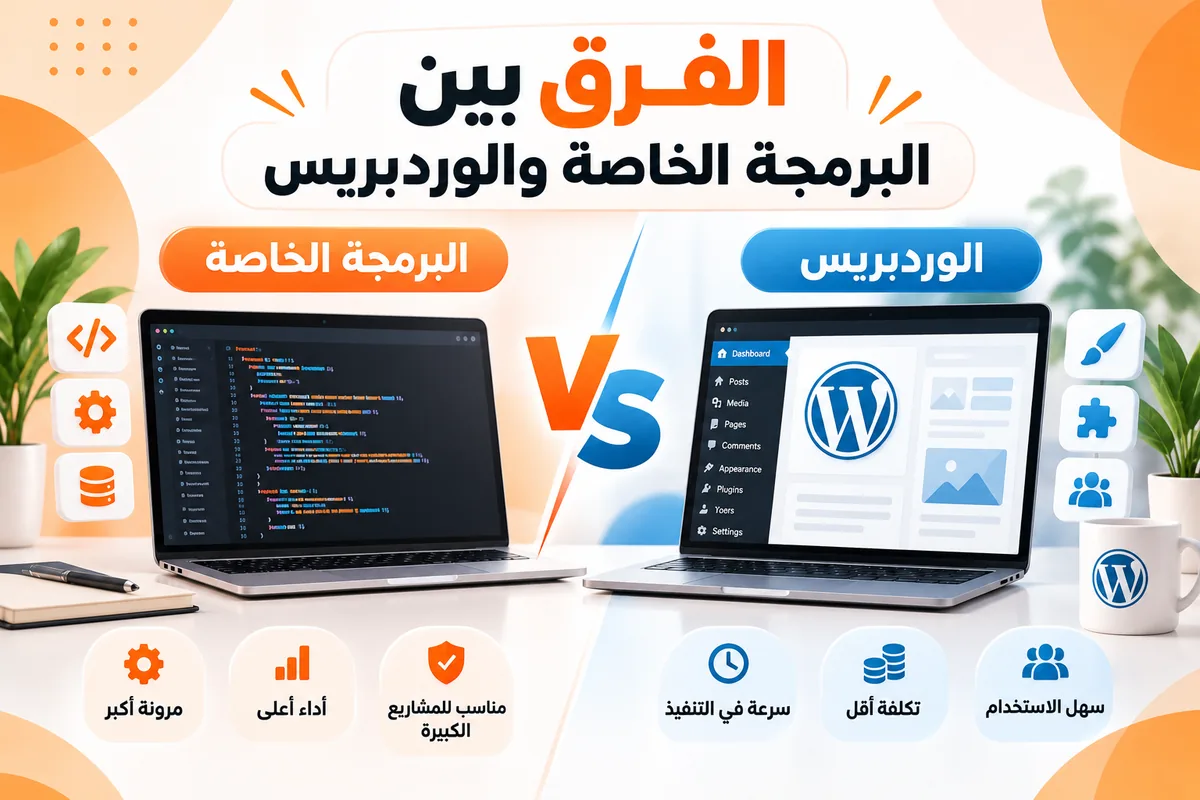
Custom Development vs WordPress Comparison
| Factor | WordPress | Custom Development |
|---|---|---|
| Initial Cost | Usually lower | Usually higher |
| Development Speed | Faster for standard projects | Usually requires more time |
| Ease of Management | Relatively easy | Depends on the admin dashboard |
| Customization | High | Very high |
| Maintenance | Requires regular updates | Requires a developer or technical team |
| Complex Features | May require custom development | Highly suitable |
| Flexibility | High | Very high |
| SEO | Can be optimized effectively | Can be fully optimized depending on implementation |
| Suitable for Standard Websites | Yes | Yes |
| Suitable for Complex Systems | Depends on the project | Highly suitable |
Can WordPress and Custom Development Be Combined?
Yes, WordPress and custom development can be combined in some projects.
The choice does not always have to be strictly between WordPress and fully custom development.
For example, WordPress can be used to manage website pages and content, while a custom plugin can be developed to provide a specific function required by the project.
This approach allows businesses to benefit from an existing Content Management System while adding custom features when necessary.
However, this solution should be carefully evaluated, especially when the required custom functionality becomes very large or complex.
In such cases, extensive modifications may make another platform or a fully custom solution more suitable.
What Should You Ask Before Choosing the Technology?
Before deciding how to build your website, it is useful to answer several important questions.
What type of website do I need?
Is it a corporate website, e-commerce store, blog, online platform, internal system, or another type of project?
What features do I need?
Do you need user registration, online payments, a booking system, inventory management, multiple permission levels, or integrations with other systems?
What is the available budget?
You should consider the budget for development, maintenance, and future improvements, not only the initial cost.
Who will manage the website?
If a content team will update the website regularly, the ease of using the admin dashboard may be an important factor.
What is your future plan?
A website may be simple when it is first launched but could later grow into a large platform. Therefore, future scalability should be considered from the beginning.
Custom Development or WordPress?
Ultimately, choosing between custom development and WordPress depends on the needs of the project rather than the name of the technology.
WordPress can be a suitable solution for websites that rely on common features and require faster development and easier content management.
Custom development can be suitable for projects that require highly specialized systems, complex functionality, and custom integrations.
Before making a decision, it is recommended to write down all project requirements and define both the current and future budget.
Then, compare the available solutions based on required features, ease of management, performance, security, and scalability.
The main goal is to choose a technology that helps the website achieve its objectives and provide a good User Experience while remaining easy to maintain and expand in the long term.
Therefore, the difference between custom development and WordPress is not only about how the website is built. It is also about the nature of the project, its requirements, and its future growth strategy.
The clearer the project requirements are from the beginning, the easier it becomes to choose the most appropriate technology.